
Introduction
The Virginia cannabis draft regulations have officially arrived, giving prospective operators their clearest look yet at what the Commonwealth’s long-awaited adult-use cannabis market will look like.
On September 9, the Virginia Cannabis Control Authority (CCA) released its initial draft regulations governing the state’s forthcoming retail marijuana market. The rules address everything from licensing and operational requirements to testing, packaging, labeling, and enforcement, marking a significant milestone as Virginia prepares to launch legal adult-use sales on July 1, 2027.
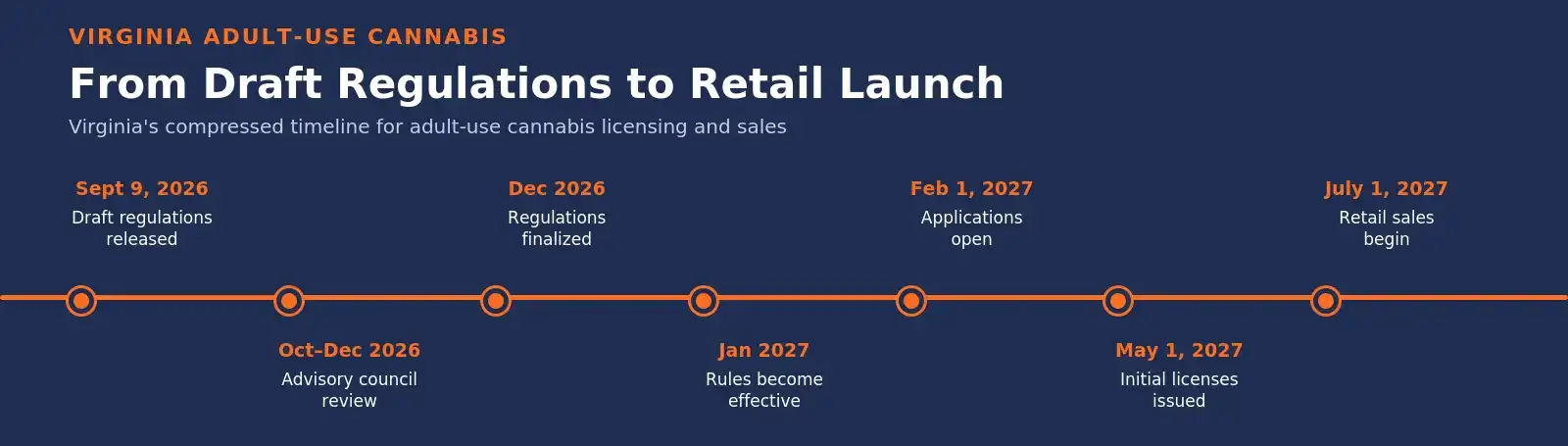
However, the release of the draft regulations also starts the clock for prospective applicants. The draft regulations were presented during the CCA’s September 9 Board meeting, which also opened the regulations to public comment. The Cannabis Public Health Advisory Council is expected to begin its review in October. The CCA expects the regulations to be finalized in December and published and effective in January 2027. By February 1, the application process will begin for certain license categories, leaving prospective operators with only a few months to understand the rules, establish their licensing strategy, and prepare for what could be a highly competitive application process.
That is why CannDelta is taking its Virginia Cannabis License Accelerator Tour directly to prospective applicants this October. From October 5–9, CannDelta will visit Abingdon, Roanoke, Richmond, Virginia Beach, and Arlington to break down Virginia’s new regulatory framework and help applicants understand what they should be doing now to prepare. The events are free to attend and will provide direct access to CannDelta’s licensing team.
Key Takeaways
- The CCA released its initial draft adult-use cannabis regulations on September 9, 2026. The regulations are not final and are expected to undergo further review before being finalized in December.
- Virginia’s adult-use market will include licenses for cultivation facilities, processing facilities, testing laboratories, transporters, delivery operators, retail stores, dual-use businesses, and microbusinesses.
- The CCA must begin accepting applications for certain license categories by February 1, 2027, with initial licenses scheduled to be issued by May 1. Legal adult-use retail sales begin July 1, 2027.
- For prospective applicants, that makes the months before the regulations become final a critical preparation period. Ownership structures, financing, application strategy, and compliance planning can take considerably longer to establish than the application window itself.
What Happened: Virginia's September 2026 Draft Regulations, Explained Simply
Virginia has been moving toward a regulated adult-use cannabis market for years, but the release of the Virginia CCA draft regulations provides prospective operators with a much clearer picture of how that market could function.
The draft rules cover the major components required to turn legalization into a functioning commercial system, including cultivation, processing, testing, transportation, delivery, retail, dual-use operations, and microbusinesses. The CCA is now responsible for developing the regulatory framework and licensing process that will govern those businesses.
However, applicants should remember that the September regulations are still a draft.
The Cannabis Public Health Advisory Council is scheduled to review the regulations beginning in October, with that review expected to conclude in December. The regulations are then scheduled to be finalized in December before being published and becoming effective in January 2027.
From there, the licensing process begins moving quickly.
By February 1, 2027, conversion applications are scheduled to open for existing pharmaceutical processors and qualifying industrial hemp processors or growers, while the application process for some microbusiness licenses will also begin. The CCA has until May 1 to issue certain initial licenses, with legal adult-use retail sales scheduled to begin statewide on July 1, 2027.
For prospective applicants, the important takeaway is not simply what is contained in the draft regulations. It is how little time there is between finalization and licensing.
An applicant who waits until January to begin preparing could find themselves trying to establish an ownership structure, develop operating procedures, organize financing, and assemble application materials while the licensing process is already underway.
The full picture is a lot to absorb from a page of regulations alone, which is exactly why CannDelta built the Virginia Cannabis License Accelerator Tour. Rather than waiting for the rules to become final and then trying to determine what they mean for your business, prospective applicants can begin building their strategy now.
Why This Can't Wait Until the Rules Are Final
December may sound like the logical time to start preparing a Virginia cannabis license application. After all, that is when the CCA expects the regulations to be finalized.
For serious applicants, however, waiting for regulatory certainty could mean surrendering several valuable months of preparation.
Cannabis licensing applications typically involve considerably more than filling out a form. Applicants may need to establish compliant corporate and ownership structures, determine which license category best fits their business model, develop financial plans, and begin assembling the policies, procedures, and supporting documentation required by regulators.
Virginia’s timeline makes that advance work particularly important. The CCA currently expects the regulations to become effective in January, with applications for some license categories beginning by February 1.
That leaves virtually no breathing room between final regulations and the beginning of licensing.
And applicants who use the draft period to prepare will not necessarily be starting from scratch when the rules become final. Instead, they can use the final regulations to refine a licensing strategy that is already taking shape.
That is the real opportunity created by the September release: applicants finally have enough information to start planning in earnest, even if some details could still change.
The advantage goes to applicants who use this period to identify what they can control now.
That could mean determining which license type to pursue, examining potential ownership issues, identifying capital requirements, or developing the operational framework that will eventually support an application. If the final regulations change a particular requirement, the strategy can be adjusted. What is much harder is trying to build that entire foundation after the application process has already begun.
There is also a competitive consideration. Virginia’s adult-use market will not offer unlimited opportunities. For example, state law caps the market at 350 marijuana retail stores statewide. The draft regulations also include placeholder license caps for Cultivation Tiers 1–4 and processing licenses, indicating that those categories may also be subject to numerical limits. Unlike the Tier 5 cultivation cap established in state law, however, the specific caps for these categories have not yet been finalized. That makes preparation particularly important for businesses hoping to establish themselves in the Commonwealth’s emerging market.
The Virginia Cannabis License Accelerator Tour is designed to help prospective applicants use this preparation period effectively. Instead of trying to interpret the developing rules alone, attendees can speak directly with CannDelta’s licensing experts about how the regulations could affect their plans and what they can begin doing before the rules become final.
Reserve Your Free Seat at the Virginia Cannabis License Accelerator Tour
Meet CannDelta on the Road This October
Reading Virginia’s draft regulations is one thing. Understanding how they apply to a specific cannabis business is another.
That is why CannDelta is taking its licensing team directly to Virginia in October for the Virginia Cannabis License Accelerator Tour, a five-city series designed for entrepreneurs, investors, existing operators, and prospective applicants preparing for the Commonwealth’s adult-use market.
The tour runs from October 5 to October 9, 2026, with stops in Abingdon, Roanoke, Richmond, Virginia Beach, and Arlington. Attendance is free, but application is required.
The sessions will be led by Dr. Sherry Boodram, CannDelta CEO, and Dr. Lucas McCann, Chief Scientific Officer, giving attendees direct access to professionals who specialize in cannabis licensing, regulatory compliance, and market-entry strategy.
Rather than simply reviewing the regulations line by line, the goal is to help attendees turn the new rules into an actionable licensing plan.
Participants will walk through the application process step by step, learn how to approach important early decisions, and have an opportunity to ask questions about their own proposed businesses. That could include questions surrounding license selection, ownership structure, site strategy, compliance requirements, or how to begin preparing while Virginia’s regulations are still being finalized.
The events will also bring prospective applicants into the same room as vendors and other industry partners, creating an opportunity to begin building some of the relationships that may eventually be needed to launch a compliant cannabis business.
Most importantly, the Roadshow gives applicants something that simply reading the Virginia adult-use cannabis rules cannot: the ability to ask how those rules apply to their plans.
For someone considering a Virginia cannabis license, October is therefore an opportunity to move from simply following the regulatory process to actively preparing for it.
For prospective applicants, those conversations can be especially valuable while the regulations remain in draft form. Instead of waiting until the licensing window opens to discover a potential problem with a business structure, property, or application strategy, attendees can begin identifying those issues months earlier.
The tour is also an opportunity for people at very different stages of the process. An established cannabis operator considering expansion into Virginia will have different questions than a first-time entrepreneur pursuing a microbusiness license. Similarly, an investor evaluating the Virginia market may be focused on different provisions than an applicant already searching for a location.
CannDelta’s team can help put those questions into the context of Virginia’s developing regulatory framework.
The result should be more than simply a better understanding of the regulations. Attendees can leave with a clearer picture of the steps between having an idea for a Virginia cannabis business and submitting a competitive, compliant application.
And with the licensing process beginning only months after the Roadshow, those steps could soon become very real.
Rule Snapshot: What the Draft Regulations Cover
Virginia’s proposed regulatory framework is extensive, but several provisions offer an early indication of how the state intends its adult-use cannabis market to operate.
Here are some of the most important numbers prospective applicants should have on their radar:
| Category | What the Draft Says |
|---|---|
| Retail store cap | Up to 350 marijuana retail stores statewide |
| Retail Licensing Fees | $4,000 application fee; $20,000 initial license fee; $15,000 annual renewal fee; $2,500 reinspection fee if a second operational inspection is required |
| Store size limit | Retail sales areas may not exceed 2,500 square feet |
| Purchase limit | Up to two ounces of marijuana per transaction |
| Edibles limit | 10 mg THC per serving and 100 mg THC per package |
| State tax | 6%, increasing to 8% beginning July 1, 2029 |
| Local tax | Localities may impose an additional tax between 1% and 3.5% |
| Delivery | Permitted, subject to where deliveries may be made |
These numbers are useful, but they only tell part of the story.
For example, Virginia’s 350-store ceiling establishes the maximum number of retail licenses available statewide; it does not mean 350 licenses will simply become available at once. The CCA is responsible for determining how licenses are issued within the framework established by state law.
Product rules will also directly influence how businesses operate. Edible cannabis products are limited to 10 milligrams of THC per serving and 100 milligrams per package, while retail transactions are subject to a two-ounce purchase limit.
Taxation adds another layer to an operator’s financial planning. Virginia law imposes a 6% marijuana tax on retail sales, scheduled to increase to 8% on July 1, 2029. Local governments can add their own marijuana sales tax, creating the possibility that the effective tax burden will vary depending on where a retail business operates.
Delivery is permitted as well, but it is not unrestricted. The draft framework places limits on delivery locations, including proximity to schools, hospitals, correctional facilities, and public gatherings.
For applicants, provisions like these are not simply regulatory details. They can influence decisions about location, store design, product strategy, pricing, operating procedures, and ultimately the economics of a proposed Virginia cannabis business.
The proposed rules also reinforce why applicants need to think beyond simply obtaining a license. A retail applicant, for example, must consider whether a proposed location and store layout can operate within Virginia’s requirements before committing significant capital to a property. Cultivators and processors face their own operational, security, testing, inventory, and compliance considerations.
The same is true for entrepreneurs interested in Virginia’s microbusiness opportunities. Microbusinesses are intended to create a pathway into the market for smaller operators, but a smaller business does not necessarily mean a simpler licensing process. Applicants still need to understand which activities their license permits and build their business around the regulatory requirements that apply to them.
This is also where Virginia’s developing market presents both an opportunity and a challenge.
Unlike entering a mature cannabis market where operators can study years of licensing decisions and established competitors, Virginia applicants are preparing while the regulatory system itself is still taking shape. Those who understand the framework early have an opportunity to build their businesses around the rules rather than trying to retrofit an existing plan once licensing begins.
For applicants looking for commercial cannabis license application support, the next several months therefore represent an important planning window. The draft regulations provide a framework. The next step is determining how a specific business fits within it.

What Virginia's Draft Rules Mean for Different License Types
Not every prospective Virginia cannabis operator will be approaching the new market from the same starting point. The license being pursued will determine many of the decisions that need to be made before an application is submitted.
For prospective retailers, Virginia’s statewide cap of 350 retail stores creates a finite market. Applicants selected through the lottery will then need to consider location as they move beyond preliminary approval, including how requirements governing store design, security, inventory, sales, and the 2,500-square-foot retail sales area limit affect potential properties.
Cultivation applicants will also need to determine which cultivation tier fits their proposed operation. Virginia’s draft framework establishes different canopy limits across cultivation tiers, with license availability and fees varying depending on the size of the operation. The draft regulations also include proposed numerical caps for Cultivation Tiers 1–4, while Tier 5 is separately limited under state law. Those distinctions could make the cultivation tier an important part of both an applicant’s licensing strategy and financial planning.
Existing pharmaceutical processors have a separate pathway into Virginia’s adult-use market through conversion. These businesses already operate within Virginia’s medical cannabis system, and the new framework provides a route for qualifying pharmaceutical processors to participate in the adult-use market rather than entering through the same process as new applicants.
Qualifying industrial hemp businesses also have a conversion pathway. Under the developing framework, conversion opportunities are available for 10 qualifying hemp cultivators and 10 qualifying hemp processors, with a $500,000 conversion fee. Conversion applications are scheduled to begin by February 1, 2027, making this a distinct route into the adult-use market for qualifying existing hemp operators.
Microbusiness applicants represent another important part of Virginia’s emerging market. For entrepreneurs pursuing a Virginia cannabis microbusiness license, understanding eligibility and the activities permitted under the license will be essential before developing the rest of the business plan.
Applicants researching impact licensee Virginia requirements should also pay particularly close attention to eligibility criteria and the licensing process, as these provisions could affect how qualifying applicants enter the market.
The specific questions may differ between applicants, but the underlying principle is the same: choosing a license category is not simply an application decision. It shapes the business that an applicant will need to build around it.
What Virginia Cannabis Applicants Should Be Doing Now
The regulations may still be in draft form, but that does not mean applicants need to wait before beginning their preparation.
One of the first steps is determining exactly which license category fits the proposed business. An applicant interested in operating a dispensary has very different regulatory, real estate, capital, and operational requirements than someone pursuing cultivation, processing, delivery, or a microbusiness opportunity.
Ownership structure should also be examined early. Cannabis licensing applications can require detailed disclosure of owners, investors, financial interests, and control of the applicant business. Resolving those relationships before an application window opens can prevent ownership questions from becoming a last-minute problem.
Site strategy is another area where applicants can begin their homework. That does not necessarily mean signing a lease immediately. It means understanding the regulatory requirements that could affect where a business can operate and incorporating those requirements into the search for suitable properties.
Applicants can also begin developing the operational foundation behind their proposed business. Security, inventory control, recordkeeping, employee procedures, product handling, compliance systems, and financial planning are all areas that can require significant preparation.
Perhaps most importantly, applicants should identify the gaps in their strategy now.
What information is still missing? Does the ownership structure work? Is sufficient capital available? What documentation will need to be assembled?
Those are much easier questions to address several months before an application deadline than several weeks before one.
The Virginia cannabis draft regulations 2026 have provided prospective operators with their first detailed roadmap. The regulations may change before becoming final, but applicants can use that roadmap now to establish the foundation of their application and adjust individual details as Virginia’s regulatory process progresses.
That is also where CannDelta Virginia license consulting can become particularly valuable: helping prospective operators turn regulatory requirements into a practical licensing strategy before the application window opens.
Frequently Asked Questions
What did Virginia's Cannabis Control Authority just release?
On September 9, 2026, the Virginia Cannabis Control Authority released its initial draft regulations for the Commonwealth’s forthcoming adult-use cannabis market.
The proposed regulations provide considerably more detail about how Virginia intends to regulate licensed cannabis businesses, including requirements affecting cultivation, processing, retail, testing, transportation, delivery, microbusinesses, products, and compliance.
These are draft regulations, not final regulations or license application guidelines. The rules will move through additional review before the CCA expects them to be finalized in December, while separate application requirements and guidance will govern the licensing process.
When do Virginia's cannabis regulations become final?
The CCA’s current Virginia cannabis licensing timeline calls for the regulations to be finalized in December 2026, followed by publication and an effective date in January 2027.
The licensing process follows quickly. Applications for certain license categories are expected to begin by February 1, initial licenses are scheduled to be issued by May 1, and legal adult-use retail sales are expected to begin on July 1, 2027.
That compressed timeline is one reason prospective applicants may benefit from beginning their preparation before the final regulations are published.
What is the Virginia Cannabis License Accelerator Tour?
The Virginia Cannabis License Accelerator Tour is CannDelta’s five-city October roadshow designed to help prospective cannabis applicants understand Virginia’s emerging licensing framework and begin preparing for the application process.
The tour will visit Abingdon, Roanoke, Richmond, Virginia Beach, and Arlington from October 5–9, 2026. Sessions will be led by CannDelta CEO Dr. Sherry Boodram and Chief Strategy Officer Dr. Lucas McCann.
than simply presenting the regulations, the sessions are intended to give prospective applicants a step-by-step application blueprint and an opportunity to ask questions about their own licensing plans.
Is the Virginia Roadshow free to attend?
Yes. The Virginia Cannabis License Accelerator Tour is free to attend and is designed for prospective applicants, entrepreneurs, investors, existing cannabis operators, and others interested in participating in Virginia’s emerging adult-use market.
The five-city tour runs from October 5–9, 2026, giving prospective applicants an opportunity to meet CannDelta’s team in person, learn more about the developing licensing framework, and ask questions about their own plans before Virginia begins accepting applications.
Where can I register for the Virginia Roadshow?
Prospective applicants can register for the free Virginia Cannabis License Accelerator Tour through CannDelta’s Virginia Cannabis License Accelerator Tour 2026 page.
With stops in Abingdon, Roanoke, Richmond, Virginia Beach, and Arlington, applicants can select the location that works best for them and reserve a seat for the October Roadshow.
Virginia’s licensing window is opening faster than many prospective applicants may realize, and reading the regulations is not the same as being prepared for the application process. CannDelta is bringing its application blueprint directly to five Virginia cities this October, giving prospective operators an opportunity to begin preparing before the Commonwealth’s adult-use market launches.