




How to Apply for an Adult-use Cannabis License in Virginia | License Types, Requirements, Fees & Timeline | Updated June 2026
Disclaimer: All information is subject to the provisions of the newly enacted Budget Bill (HB30), final agency rulemaking, and the Virginia Cannabis Control Authority (CCA). Details regarding specific application forms, exact general fee amounts, and final Board regulations are still being finalized and are subject to change.
Virginia is preparing to open adult-use cannabis licensing in Early 2027, with retail sales launching on July 1, 2027. If you’re searching for:
- “How to apply for a Virginia cannabis license”
- “Virginia cannabis microbusiness license requirements”
- “Virginia marijuana retail license application 2026”
- “Virginia social equity (impact) cannabis license rules”
- “Virginia cultivation license tiers explained”
This article breaks down everything you need to know.
How to Get a Virginia Adult-use Cannabis License in 2026-2027
Virginia is anticipated to begin accepting adult-use cannabis license applications in early 2027, subject to the newly enacted legislation and final Virginia Cannabis Control Authority (CCA) regulations.
If you’re planning to apply for a Virginia cannabis license, you need to understand:
- Which license type fits your business model
- Whether you qualify as an Impact Licensee (social equity)
- Whether a lottery will apply
- How ownership limits work
- What license caps exist through January 1, 2028
- When retail sales are expected to begin
Read this full guide or checkout the video below for the complete information on Virginia’s adult-use cannabis license applications.
If you are ready to take the first step, contact us today and let’s begin preparing your Virginia Cannabis License application.
Virginia is building a controlled, capped cannabis market with limited early entry pathways and strict ownership rules. Early preparation will be critical.
Below is a complete breakdown of Virginia cannabis license types, microbusiness requirements, fees, residency rules, and the 2026–2027 timeline.
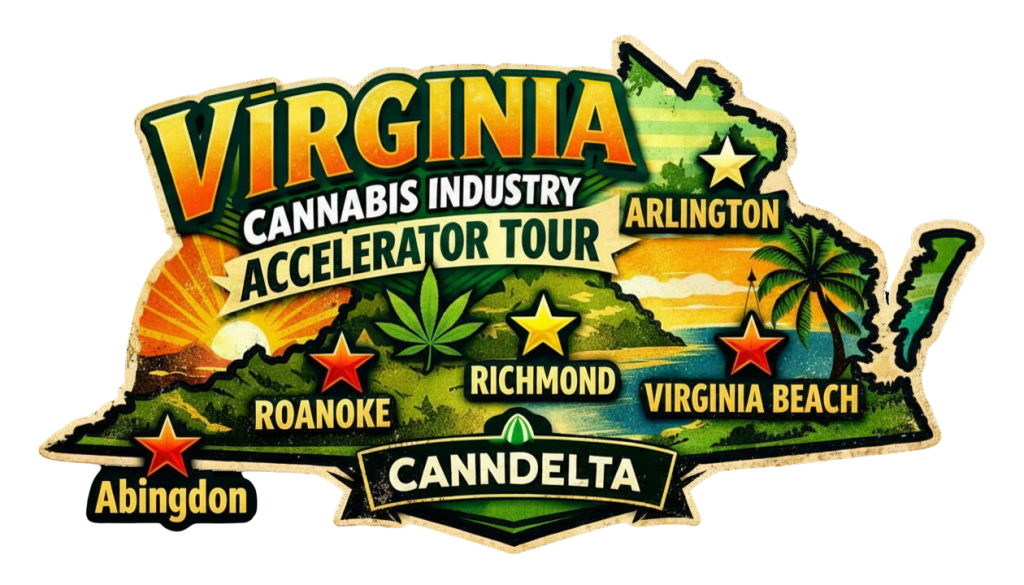
CannDelta is coming to Virginia October 5-9, 2026. Join Our Full-day Bootcamp Style Workshop and Learn Everything You Need to Succeed in the Commonwealth
Dates, Timings, and Cities
| Date | City |
| October 5, 2026 (2:00 PM – 8:00 PM) | Abingdon |
| October 6, 2026 (2:00 PM – 8:00 PM) | Roanoke |
| October 7, 2026 (2:00 PM – 8:00 PM) | Richmond |
| October 8, 2026(2:00 PM – 8:00 PM) | VA Beach |
| October 9, 2026 (2:00 PM – 8:00 PM) | Arlington |
Virginia’s Adult-use Cannabis Application Timeline (2026–2027)
If you’re wondering, “When can I apply for a Virginia cannabis license?” here’s the projected timeline:
Late 2026 – Early 2027:
Application Preparation: The window for application preparation is the most critical phase for any prospective licensee. By law, the Virginia Cannabis Control Authority (CCA) will announce the commencement of the licensing period in advance, outlining the exact types and numbers of licenses available, as well as the dates they will begin accepting applications.This period involves more than just paperwork; it requires building a robust corporate foundation.
How CannDelta Helps: We assist clients in navigating business registration, coordinating mandatory background checks, and drafting the core pillars of a winning application. Our experts specialize in developing comprehensive Business Plans, Security Plans, and Standard Operating Procedures (SOPs) that meet Virginia’s regulatory expectations.
Early 2027:
Application Window Opens & Seed-to-Sale Implementation: Virginia is projected to begin accepting adult-use cannabis license applications ahead of the summer launch. In a competitive licensing environment, the quality and accuracy of your initial submission are paramount. During this time, the state’s mandatory Seed-to-Sale tracking system will also be implemented, which is required to track all marijuana from the seed or immature plant stage until it is sold to a consumer, dispensed, or destroyed. Mastery of this system is a prerequisite for maintaining your license and avoiding costly compliance infractions.
How CannDelta Helps: We provide full-scale Application Management. Our team performs rigorous quality assurance on all documents to ensure total compliance with CCA requirements, minimizing the risk of delays or administrative denials. We also provide Technical Training and Systems Integration support to help you select and implement the right technology stack to ensure your inventory management is seamless and compliant with Virginia’s tracking mandates from day one.
Spring – Mid 2027:
License Issuance & Impact Licensee Lotteries:
On or before May 1, 2027, the state will execute three Priority Milestone Waves:
- Wave 1: 100 Microbusiness Licenses
- Wave 2: Dual-Use Medical Conversions ($10M Fee)
- Wave 3: 20 Early Hemp Cultivators/Processors ($500K Fee)
If the number of qualified applicants seeking a specific type of license exceeds the number of licenses available, the Authority will conduct a random lottery. To prioritize equity, the Authority will first conduct a dedicated lottery exclusively for Impact Licensee applicants. Any Impact Licensee applicants not selected in this initial draw will then be included in the general applicant pool lottery.
How CannDelta Helps: We specialize in Priority Licensing Strategy and Regulatory Monitoring. We help determine your eligibility as an Impact Licensee and ensure your corporate structure aligns with the law to maximize your chances in the application or lottery process. As the CCA issues its finalized regulations, we pivot your operational strategy in real-time to ensure you remain in compliance with the most current rules.
July 1, 2027:
Market Launch: Official start of adult-use retail sales in Virginia
How CannDelta Helps: Beyond the license, we assist with Post-Licensing Support, Operational Readiness Inspections, and Marketing. We conduct “mock audits” to prepare your team for the real thing, ensuring that when the doors open, your business is a model of regulatory excellence.
How to Apply for a Virginia Cannabis License
Preparations should begin now, to ensure you have everything ready to put together a strong application.
Typical application components include:
- Business formation documents
- Ownership disclosures
- Financial documentation
- Operating procedures
- Security plan
- Community impact plan
- Background checks
- Compliance framework
- Inventory tracking integration plan
Incomplete applications in a capped or lottery-based system rarely succeed.
Looking for a cannabis consulting firm in Virginia? Partner with CannDelta to access a dedicated team committed to your success. With extensive experience across North America and helping launch over 450 businesses, we offer valuable insights into the ever-evolving cannabis industry. Our team is highly knowledgeable about Virginia’s regulatory landscape and equipped with the tools to help you launch your cannabis business smoothly.
Why Virginia’s Adult-Use Cannabis Market Is Structurally Unique
Virginia’s adult-use cannabis market is not an open, unlimited licensing system. It is intentionally structured to control growth, manage supply, and prevent early market saturation through at least January 1, 2028.
This design creates a high-value environment where well-prepared applicants can secure a foothold in a protected market. Unlike states that issued thousands of licenses immediately, Virginia has implemented strategic caps on high-impact categories. Here are the confirmed statewide caps effective through January 1, 2028:
- Retail Store Licenses: Capped at a maximum of 350 statewide
- Tier V Cultivation Licenses: Strictly limited to only five (5) licenses
- Microbusiness Licenses: The Board will issue exactly 100 Microbusiness Licenses as part of a ‘Wave 1’ priority milestone on or before May 1, 2027. These operators benefit from unique vertical integration, allowing them to cultivate (up to 5,000 sq. ft. indoors or 10,000 sq. ft. outdoors), process, and sell products at retail under a single license.
- Flexible Growth Categories: To prevent bottlenecks, the Board may issue as many Marijuana Transporter or Marijuana Processing Facility licenses as it deems necessary
The Strategic Value of Tier V Scarcity
One of the most significant structural elements is the scarcity of Tier V cultivation. While the previous overall cap on the number of cultivation facilities for Tiers I–IV has been removed, the strict limit of only five Tier V licenses (authorizing up to 35,000 sq. ft. of indoor canopy) creates a highly competitive environment for large-scale operators. This positions Tier V as a premium, limited asset class within the Virginia market.
Priority for Small-Scale and Impact Licensees
Virginia’s finalized law signals a strong policy focus on ensuring small-scale and equity-driven businesses can compete. If the regulatory Board decides to limit the number of licenses available for any uncapped license type, the law mandates that the number of licenses reserved for “Impact Licensees” must be equal to or greater than those available to all other applicants.
Furthermore, Impact Licensees and microbusinesses are uniquely permitted to enter into cooperative agreements, lease space and equipment to operate on another licensee’s premises, and process marijuana out of a shared processing space
Impact Licensees will also have access to fee waivers and low- or zero-interest loans through the Virginia Cannabis Equity Business Loan Fund.
Vertical Integration and Expansion Flexibility
While testing facilities and microbusinesses must remain completely independent, vertical integration is permitted across other license types. This allows businesses to structure multi-license strategies—such as combining cultivation, processing, and retail—provided they stay within the general ownership cap of five total licenses.
Notably, this five-license cap excludes marijuana transporter licenses, and operators are restricted to holding no more than one Tier V cultivation license.
With the removal of the overall limit on lower-tier cultivation facilities, operators have long-term flexibility to scale their production as the market matures.
Virginia is building a measured, scarcity-driven cannabis market with deliberate pacing through 2028. Operators who understand this framework and align their capital and ownership structures accordingly will be best positioned to secure and scale within the Commonwealth.
Virginia Cannabis License Types Explained
If you’re searching “What types of cannabis licenses are available in Virginia?” here’s the breakdown.
Virginia Retail Marijuana Store License
This license allows for the direct sale of marijuana and marijuana products to consumers aged 21 and older.
Key Requirements:
- Transactions: All exchanges with consumers must be direct and face-to-face. Retailers are strictly prohibited from using automated vending machines or drive-through sales windows.
- Delivery: Retailers are authorized to deliver products directly to consumers in person at a residence or business, or by utilizing a licensed marijuana delivery operator. Deliveries to public gathering places, schools, and military bases are prohibited.
- Third-Party Platforms: Retailers may not sell or market products through an internet-based sales platform operated by a third party.
- Size Limit: Establishments are limited to a maximum of 2,500 square feet of retail floor space.
- Licensure: A separate license is required for each separate place of business.
- Activity Restriction: Retailers cannot cultivate or process marijuana unless they hold a separate microbusiness license or dual-use pharmaceutical processor permit authorizing those activities
- Product Cap: Retailers may not sell more than two (2) ounces of marijuana (or an equivalent amount of products) to one person in a single transaction.
- License Cap: The total number of retail marijuana store licenses is strictly capped at 350 statewide.
Virginia Cannabis Cultivation License (Tier I–V)
These licenses authorize the cultivation, labeling, and packaging of marijuana. Licenses are divided into five tiers based on the allowed canopy size.
- Tier I: Up to 5,000 sq. ft. (Indoor or Outdoor).
- Tier II: Up to 10,000 sq. ft. (Indoor or Outdoor).
- Tier III: Up to 15,000 sq. ft. (Indoor only).
- Tier IV: Up to 25,000 sq. ft. (Indoor only).
- Tier V: Up to 35,000 sq. ft. (Indoor only).
Important Market Updates:
- License Caps: There is currently no statutory limit on the number of licenses for Tiers I–IV
- Tier V Scarcity: Tier V is strictly limited to a total of only five (5) licenses statewide until January 1, 2028
- Greenhouse Cultivation: Cultivation in a secure agricultural greenhouse is legally considered indoor cultivation, provided it is surrounded by a privacy fence at least eight feet tall with monitored access
- Outdoor Restrictions: Only one license authorizing outdoor cultivation may be issued per parcel of land; this also applies to contiguous parcels under common ownership or control.
How Long Does it take to Build a Cannabis Cultivation Facility?
While the buildout timeframe depends on various factors, the regulatory process includes specific deadlines you must meet once your application is approved by the Virginia Cannabis Control Authority (CCA):
- Securing a Location: Awarded applicants receive preliminary license approval and then have 18 months to secure a physical location, pass local zoning checks, and request necessary state inspections.
- Extensions: A one-time 6-month extension may be granted by the Authority if the applicant demonstrates good faith efforts to convert a preliminary license approval into a final license.
Operational Deadline: A license shall be revoked if the business is not operational within 12 months of the final license issuance
To stay on track, it’s important to work with experienced consultants, contractors, and compliance experts who understand cannabis-specific buildout requirements. Delays are common during the permitting phase, so early preparation is critical.
Contact CannDelta today to get started.
Disclaimer: The time to build out a Cannabis Cultivation Facility depends on various factors like time, capital and other resources and can vary significantly based on individual cases. Talk to us, to get an accurate timeline based on your needs.
Virginia Cannabis Processing / Manufacturing License
If you’re searching “Virginia cannabis manufacturing license requirements,” here’s the full breakdown:
- Authorized Activities: Compliance: Must implement mandatory seed-to-sale tracking and comply with all sanitary and security standards. Additionally, any facility processing edible marijuana products must comply with the Department of Agriculture and Consumer Services regulations for food manufacturers
- Retail Restriction: Licensees cannot sell directly to consumers.
- License Cap: There is currently no limit on the number of processing facility licenses.
- Compliance: Must implement mandatory seed-to-sale tracking and comply with all sanitary and security standards.
Virginia Cannabis Microbusiness License
This is one of the most searched categories. If you’re asking:
“What is a Virginia cannabis microbusiness license?”
“Who qualifies for a Virginia microbusiness license?”
“Can a microbusiness grow and sell in Virginia?”
Here is what you need to know:
- Vertically Integrated: A single license that allows the holder to cultivate, process, and sell marijuana products at retail.
- Cultivation Limits: Up to 5,000 sq. ft. for indoor canopy and up to 10,000 sq. ft. for outdoor canopy
- Location Flexibility: Unlike other licenses, a microbusiness may conduct authorized activities at up to two separate locations within 20 miles of one another.
Restrictions:
- Licensees cannot hold interests in any other marijuana establishment license type.
- Common ownership and control are required for both locations.
- Licensees cannot perform the same activity (e.g., retail sales) at both locations.
Cooperative Agreements: Microbusinesses may enter into cooperative agreements to lease space or equipment, cultivate, and share processing space with other authorized licensees
Other Virginia Cannabis License Types
In addition to retail, cultivation, and microbusiness licenses, the framework includes the following essential categories:
Virginia Marijuana Transporter License
- Authorized Activities: Authorized to transport marijuana, marijuana products, immature marijuana plants, and marijuana seeds between licensed marijuana establishments
- License Cap: There is no limit on the number of transporter licenses.
- Ownership Advantage: Transporter licenses do not count toward the general limit of five total marijuana licenses per person.
Requirements: A separate license is required for each place of business, and all products must be tracked through the state’s mandatory system.
Virginia Marijuana Testing Facility License
- Authorized Activities: Authorized to research, develop, transport, and test marijuana, marijuana products, and other substances for contaminants, safety, and potency
- Independence Requirement: To ensure market integrity, testing facility licensees cannot hold any interest in cultivation, processing, transporter, retail, or microbusiness licenses.
- Accreditation: Licensees must obtain and maintain ISO/IEC 17025 accreditation by a third-party body.
Virginia Marijuana Delivery Operator License
- Authorized Activities: Authorized to take possession of products from a retail marijuana store or microbusiness and deliver them directly to consumers.
- Restrictions: Delivery must be made in person to a consumer at a residence or business; deliveries to any military base, child day center, school, correctional facility, hospital, marine terminal, the State Capitol, or public gathering places (including sporting events, festivals, fairs, races, concerts, and terminals of public transportation companies) are strictly prohibited
- Coordination: This license does not authorize cultivation or processing; it serves as the final link between retailers and consumers.
Virginia Cannabis License Caps (Through January 1, 2028)
Virginia Cannabis License Caps
- Retail Store Licenses: Capped at 350 statewide.
- Tier V Cultivation: Strictly limited to a total of 5 licenses until January 1, 2028
- Cultivation Tiers I–IV: There is currently no statutory limit on the number of licenses for these tiers.
- Marijuana Processing Facilities: There is no limit on the number of processing licenses.
- Marijuana Transporters: There is currently no statutory limit on the number of transporter licenses.
Updated Ownership and Interest Limits
- Total License Limit: Generally, no person or entity may hold an interest in more than 5 total licenses.
- Transporter Exemption: Marijuana Transporter licenses do not count toward the five-license ownership limit.
- Tier V Restriction: An individual or entity is prohibited from holding an interest in more than one Tier V cultivation license.
- Microbusiness Exclusivity: Microbusiness licensees are vertically integrated but are strictly prohibited from holding an interest in any other license type.
- Testing Facility Independence: Marijuana Testing Facilities must remain independent; they cannot hold interests in cultivation, processing, retail, transporter, delivery operator, or microbusiness licenses.
- Separate Premises: A separate license is required for each separate place of business.
- Definition of Interest: An “interest” is defined as a direct or indirect equity ownership, partial equity ownership, or any other financial or economic interest representing at least 10% of the ownership, voting power, or economic value of an entity, or acting as an investor, partner, member, officer, director, or serving in any other management position.
Location Flexibility for Microbusinesses
- Dual Locations: Unlike the previous “one location only” rule, microbusinesses may now operate in up to two separate locations.
Proximity and Use: These locations must be within 20 miles of each other, both locations must operate under the same microbusiness license and common ownership and control, each location must be appropriately zoned and approved by the locality, and the licensee cannot perform the same single license privilege (such as retail sales) at both sites
Virginia's Special Pathways for Existing Operators
Early Hemp Cultivators/Processors Priority:
As part of the state’s priority licensing milestones, the Board will authorize 20 Early Hemp Cultivators/Processors during ‘Wave 3’ on or before May 1, 2027. To qualify for this pathway, eligible hemp operators must pay a $500,000 fee.
Pharmaceutical Processor Dual-Use
Existing medical cannabis operators can apply for “dual-use” privileges (medical and adult-use) by paying a one-time $10 million licensing conversion fee. Effective June 1, 2027, no previously issued medical permit will remain valid unless the processor has received dual-use verification from the Board
- Requirements: Payment of a $10 million conversion fee (installments allowed over 3 years) and commitment to a three-year impact licensee business accelerator plan.
- Expansion: Authorized dual-use processors are permitted an indoor cultivation canopy of up to 70,000 square feet.
The Application and Selection Process
- Deficiency Notices: If an application is submitted missing required info or the fee, the applicant has exactly 10 calendar days to correct it or the application is rejected.
- Lottery System: If qualified applicants outnumber available licenses, an impartial random lottery will be held. Impact applicants are entered into a dedicated lottery first; those not selected are then moved into the general pool.
- Preliminary Approval: Awarded applicants receive preliminary approval and have 18 months to secure a location and pass local zoning checks (a one-time 6-month extension may be granted).
Location and Local Requirements
- Setbacks: Retail and microbusiness locations must be at least 1,000 feet from any hospital, public/private school, institution of higher education, or child day program. However, local governments may adopt an ordinance to decrease this minimum distance requirement.
- Zoning: They cannot be located where they will adversely affect real property values or substantially interfere with the usual quietude and tranquility of a residential area.
- Local Authority: Local governments have 30 days to submit objections to a license application and may adopt ordinances to fix the operating hours of retail stores.
Taxes
- State Tax: Retail sales of marijuana are subject to a 6% state tax**, which will automatically increase to 8% starting July 1, 2029*. This is in addition to the standard 5.3% Virginia retail sales and use tax.
- Local Tax: Each locality is required to levy an additional local tax of 1% to 3.5% on retail sales within its jurisdiction
Virginia Impact Licensee (Social Equity) Requirements
If you’re searching:
- “Virginia social equity cannabis license rules”
- “Virginia Impact Licensee eligibility”
- “How do I qualify as an impact licensee in Virginia?”
Virginia uses a specific two-part qualification test to identify Impact Licensees. To qualify, an applicant must have at least 51% ownership and direct control by individuals who meet both of the following criteria.
Part 1 – Residency Requirement
Qualifying owners must meet one of the following residency criteria.
- Have resided between the years 1999 and 2025 in a jurisdiction determined to have been disproportionately policed for marijuana crimes (based on census tract data).
- Have resided for at least three of the past five years in a historically economically disadvantaged community
Part 2 – Life Status Criterion
In addition to the residency requirement in Part 1, qualifying owners must also meet at least one of the following:
- Prior Conviction: Have been convicted of or adjudicated delinquent for any violation of § 18.2-248.1, former § 18.2-250.1, or subsection A of § 18.2-265.3 as it relates to marijuana (or any substantially similar offense under the laws of another jurisdiction).
- Family Impact: Be the parent, child, sibling, or spouse of a person convicted of or adjudicated delinquent for the offenses listed above.
- Education: Have attended a public elementary or secondary school located in a historically economically disadvantaged community for at least five years.
- Pell Grant: Have received a Federal Pell Grant or attended for at least two years a college or university where at least 30% of students, on average, are Pell Grant eligible.
- Military Service: Be a veteran of the Armed Forces of the United States.
- Distressed Farmer: Have qualified for financial assistance or relief from the U.S. Department of Agriculture as a distressed farmer within the last five years.
⚠️ Important Note: Meeting a Part 2 criterion (like a prior conviction or veteran status) alone does NOT qualify an applicant. You must also meet the residency requirements in Part 1.
Ownership Requirements for Impact Licensees
- Minimum Ownership: The business must have at least 51% ownership and direct control by individuals who meet the criteria above.
- Transfer Restriction: Impact Licensees are prohibited from selling or transferring a controlling interest (more than 49%) in their license for a period of five years from the date of issuance. However, the Board may allow exceptions for transfers made as part of an estate plan to a family member or into a trust for the benefit of the licensee’s immediate family
- Financial Protections: The Board provides protections against market dominance, ensuring that if the Board limits any uncapped license category, the number of licenses available to Impact Licensees must be equal to or greater than those available to all other applicants.
- Anti-Predatory Protections: If the Board determines an impact license was obtained through a fraudulent financial transaction or a predatory operating agreement, the Board will immediately begin revocation proceedings and require the licensee to repay the full value of any waived application or licensing fees.
Unsure whether you qualify as an Impact Licensee? The qualification process involves detailed census tract and legal analysis. We conduct comprehensive ownership structure audits and eligibility verifications to ensure your application is built on a solid foundation. Contact us today for a consultation.
Apply for a Virginia Adult-use Cannabis License With CannDelta
Virginia’s adult-use cannabis application window is projected to open in early 2027, ahead of the July 1, 2027, market launch.
Licenses are strictly limited. Tier V cultivation is capped at five licenses until January 1, 2028. Retail store licenses are permanently capped at 350 statewide. The Board will issue exactly 100 Microbusiness Licenses as part of a ‘Wave 1’ priority milestone on or before May 1, 2027. The law also ensures priority equity access by mandating that if the regulatory Board limits any uncapped license category, the number of licenses available to Impact Licensees must be equal to or greater than those available to all other applicants.
Operators who win will be those who prepare early, structure ownership correctly, and submit defensible applications. Partner with CannDelta to access a dedicated team committed to your success. With extensive experience across North America and helping launch over 450 businesses, we offer valuable insights into the ever-evolving cannabis industry. Our team is highly knowledgeable about Virginia’s regulatory landscape and equipped with the tools to help you launch your cannabis business smoothly.
We help clients:
- Structure ownership for Impact qualification
- Choose the right tier or microbusiness strategy
- Draft compliant applications
- Prepare for regulatory review
- Develop security and SOP manuals
- Navigate municipal approvals
- Draft a compliant business framework
- Build an Inventory tracking integration plan
- Conduct pre-submission audits
- Support build out
- Connect with trusted vendors and partners
- Prepare for final CCA inspection
Virginia is building a controlled, capped market through January 1, 2028.
Early preparation = competitive advantage. Let’s start your Virginia cannabis license application today!
Frequently Asked Questions about Virgina's Adult-use Cannabis Licenses - SOLVED!
Do I need to live in Virginia to get a cannabis license?
No, Virginia’s finalized adult-use cannabis law does not enforce a blanket residency requirement for standard business licenses. The final legislation actually removed previous language that would have required social equity applicants to have lived or been domiciled in the Commonwealth for at least 12 months.
However, past residency is still a strict requirement if you are applying for priority status as an Impact Licensee:
Impact Licensee Qualifications: To qualify for this priority designation, a business must have at least 51% ownership and direct control by individuals who meet specific historical residency criteria.
Specifically, these owners must have either resided in a disproportionately policed jurisdiction between 1999 and 2025, or resided in a historically economically disadvantaged community for at least three of the past five years.
What is a Virginia cannabis microbusiness license?
A Virginia cannabis microbusiness license is a unique, vertically integrated license that allows a single business to cultivate, process, and sell marijuana products at retail under one license.
Here are the key details and requirements for a microbusiness license under the newly finalized law:
Vertical Integration: It authorizes the licensee to conduct the activities of a marijuana cultivation facility, processing facility, and retail store.
Cultivation Limits: Microbusinesses are permitted to cultivate marijuana with an indoor canopy of up to 5,000 square feet and an outdoor canopy of up to 10,000 square feet.
Location Flexibility: A microbusiness may conduct its authorized activities at up to two separate locations within the state.
However, these locations must be within 20 miles of each other, be appropriately zoned and approved by the locality, operate under the same license and ownership, and cannot exercise the same single license privilege (e.g., they cannot conduct retail sales at both locations).
License Restrictions: A microbusiness licensee is strictly prohibited from holding or controlling any other type of marijuana establishment license.
Cooperative Agreements: Microbusinesses are uniquely permitted to enter into cooperative agreements to lease space and equipment. They may also cultivate, process, and sell products on the premises of another licensee, and process marijuana out of a shared processing space.
Compliance Requirements: Microbusinesses are subject to the same statutory and regulatory requirements as standard cultivators, processors, and retailers. This includes adhering to the state’s mandatory seed-to-sale tracking system and meeting all strict sanitary and security standards
What are the residency requirements for a Virginia Impact Licensee?
Under Virginia’s finalized law, the previous requirement that social equity applicants must have lived or been domiciled in the state for at least 12 months has been removed.
Instead, to qualify specifically for priority status as an Impact Licensee, a business must have at least 51% ownership and direct control by individuals who meet one of the following two historical residency criteria:
Disproportionately Policed Area: The individual resided between the years 1999 and 2025 in a jurisdiction determined to have been disproportionately policed for marijuana crimes (based on census tract data).
Economically Disadvantaged Area: The individual resided for at least three of the past five years in a historically economically disadvantaged community.
(Note: Meeting the residency requirement is only the first half of the qualification test. To fully qualify as an Impact Licensee, these specific owners must also meet at least one additional “life status” criterion, such as having a prior marijuana conviction, attending school in an economically disadvantaged community for at least five years, receiving a Pell Grant, or being a U.S. military veteran.)
When will Virginia adult-use cannabis sales begin?
Virginia’s legal adult-use cannabis sales are officially scheduled to begin on July 1, 2027.
This launch date was finalized as part of the recently passed budget agreement and compromise negotiated with Governor Abigail Spanberger.
Is there a lottery for Virginia cannabis licenses?
Yes, Virginia will use a lottery system to award cannabis licenses if applicant demand exceeds the available supply.
If the number of qualified applicants seeking a specific type of license is greater than the number of licenses available, the Virginia Cannabis Control Authority is mandated to conduct an impartial, random lottery to select applicants for preliminary license approval.
To prioritize equity within the market, the Authority will first hold a dedicated lottery exclusively for Impact Licensee applicants. If an Impact Licensee is not selected during this initial priority draw, they will then be automatically rolled over and included in the general lottery pool alongside all other qualified applicants.
How many cannabis licenses will Virginia issue?
Under Virginia’s finalized adult-use cannabis law, there is not a single overall limit on the total number of cannabis licenses the state will issue. Instead, the framework establishes strict statutory caps for certain high-impact categories and leaves other categories open to the discretion of the regulatory Board.
Here is the exact breakdown of how many licenses Virginia will issue based on the finalized legislation:
Retail Store Licenses: The state will issue a maximum of 350 retail marijuana store licenses statewide.
Tier V Cultivation Licenses: This category (for the largest indoor canopy size of up to 35,000 square feet) is strictly limited to only five (5) licenses prior to January 1, 2028. Beginning January 1, 2028, the Board will evaluate market conditions and determine if additional Tier V licenses should be issued.
Other License Types: For all other license categories—including Microbusinesses, Cultivation Tiers I–IV, Processing Facilities, Marijuana Transporters, Delivery Operators, and Testing Facilities—there is currently no strict statutory cap.The regulatory Board is authorized to issue as many of these licenses as it deems necessary to ensure a sufficient supply, avoid market dominance, and support small businesses.
Medical Dual-Use Licenses: Existing medical cannabis operators (pharmaceutical processors) are permitted to enter the recreational market by paying a one-time $10 million conversion fee. By law, Virginia allows only one pharmaceutical processor permit per health service area, with each processor allowed to open up to five cannabis dispensing facilities within that same area.
Protections for Impact Licensees: While there are no set limits on several of the license categories, the law builds in a specific protection for equity applicants. If the Board decides to limit the number of licenses available for any of the uncapped categories, the law mandates that the number of licenses reserved for Impact Licensees must be equal to or greater than the number of licenses available to all other applicants. This same 50% protection applies if the Board decides to issue additional Tier V cultivation licenses after 2028
How much does an adult-use Virginia cannabis license application cost (fee)?
Based on the finalized legislation in the sources, the exact dollar amount for the adult-use Virginia cannabis license application fee is not specified in the law itself. Instead, the statute delegates the authority to determine these costs to the Board of Directors of the Virginia Cannabis Control Authority (CCA).
Here is what the law outlines regarding the application and licensing fees:
Determined by the Board: The Board is tasked with establishing the application fees, as well as the annual state license fees, which must be set at an amount sufficient to cover the costs of regulating the marijuana establishments
Payment and Non-Refundability: The required application fee must be paid at the time the application is filed and will not be refunded.
Additional Background Check Costs: The application fee is strictly for the application itself and is in addition to the actual costs charged by the Department of State Police, the FBI, or the Central Criminal Records Exchange for processing mandatory fingerprinting and criminal history background checks.
Waivers for Impact Licensees: The Board is required to establish regulations determining what percentage of application or license fees will be waived for qualified “Impact Licensees.” This is designed to promote participation in the market by equity applicants who may have an inability to pay standard application and license fees.
Because the Board has to establish these fees via its upcoming regulations, the exact cost to apply will be announced closer to when the application window opens in early 2027.
Do you need to secure a property before applying?
The law explicitly states that applicants are not required to have secured a place or premises until the final stage of the license approval process.
If your application is selected during the lottery process, you will be awarded a “preliminary license approval.
From that point, you will have 18 months to secure a physical location, pass local zoning checks, and provide the Authority with the address and legal property description where the establishment will operate.
If you make good faith efforts to convert your preliminary approval into a license but need more time, you may be granted a one-time extension of up to six months.
Furthermore, if you qualify as an Impact Licensee (social equity applicant), the state specifically mandates a waiver of any requirements to show current possession and control of a proposed property or proof of funds at the time of your application