
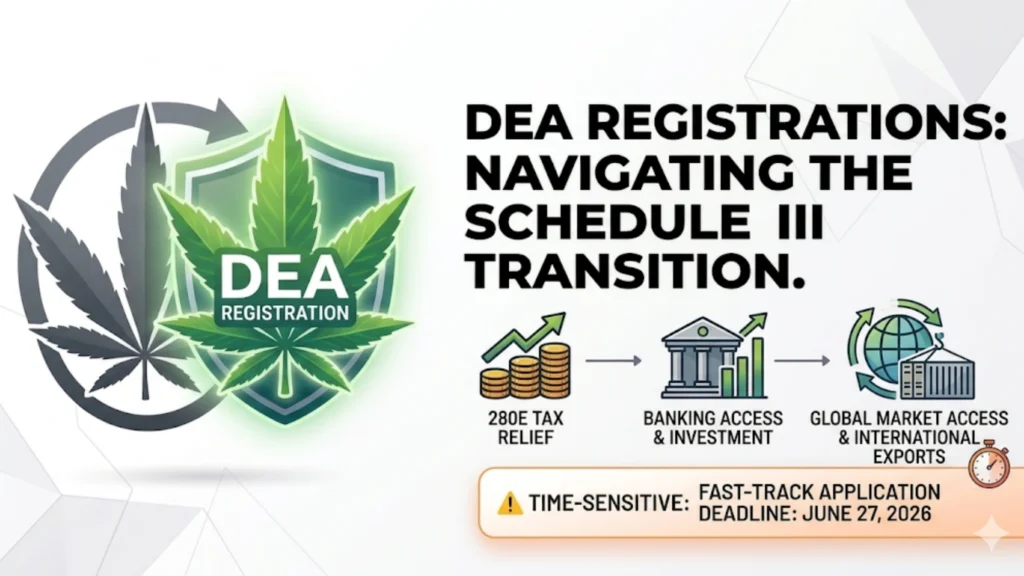
TIME-SENSITIVE: The DEA's 60-Day "Fast-Track" Window is Open
The reclassification of state-licensed medical marijuana to Schedule III marks one of the most significant regulatory shifts in modern cannabis history. For the first time, eligible medical cannabis operators can function under the same federal frameworks as other legal medical businesses.
However, this transition requires an experienced understanding of DEA registration, federal compliance, and strict security protocols. At CannDelta, our team of regulatory experts and former government inspectors are ready to lead your business through this complex federal landscape.
The Opportunity: Why Schedule III Matters
The shift from Schedule I to Schedule 3 (III) changes the landscape of the medical cannabis industry. Businesses that secure DEA registration can unlock unprecedented advantages:
State-licensed medical cannabis providers are officially exempt from the punitive restrictions of IRS Section 280E. This means your business can finally deduct ordinary and necessary business expenses—such as payroll, marketing, rent, and utilities—under IRC Section 162, drastically increasing your corporate profitability and cash flow.
- The CannDelta Execution: If your facility operates under a dual-license model (handling both medical and adult-use/recreational markets), your tax realities are fundamentally split. Recreational cannabis remains strictly under Schedule I, meaning 280E still applies to that side of your business. We design and implement the ironclad physical inventory separation and structural cost-accounting barriers required to safely isolate your medical deductions and protect your business against aggressive IRS audits.
Global Export Capabilities:
With a federal DEA manufacturer or distributor registration, U.S. operators can finally tap into the highly lucrative international medical cannabis market. Much like licensed producers in Canada, federally compliant U.S. businesses can legally export medical cannabis to participating nations worldwide (e.g., Europe, Australia, South America).
- The Critical Caveats: A DEA registration is not an open passport to ship products overseas. International trade remains heavily regulated. Every single international shipment requires an individually approved DEA Export Permit, which the federal government will only grant if you possess a corresponding, valid Import Permit issued by the destination country’s regulatory body. Furthermore, all movements must strictly comply with the 1961 Single Convention on Narcotic Drugs, meaning shipments must be explicitly designated for legitimate medical or scientific use and are bound by the target nation’s annual domestic drug quotas. CannDelta builds the rigorous Quality Management Systems (QMS) required to achieve GACP and EU GMP certifications, ensuring your facility satisfies both international health standards and federal export mandates.
Interstate Commerce:
With a federal DEA license as a registered manufacturer or distributor, a legal federal baseline is established for transporting medical cannabis across state lines. This opens the door to centralized distribution hubs and cross-border supply chains that were completely impossible under Schedule I.
- The Logistics Reality: Because cannabis is not yet an across-the-board, FDA-approved prescription drug, interstate distribution cannot operate completely unchecked. It remains tethered to state-by-state medical frameworks and requires distinct DEA registrations for each physical facility operating across state boundaries. We engineer the multijurisdictional compliance pathways and transport protocols necessary to securely bridge state regulations with Title 21 CFR federal transit requirements.
Federal Medical Validation:
Aligning with Schedule III status allows for a more integrated relationship with the traditional healthcare system and standard medical prescribing practices. Medical cannabis transitions away from non-binding state “recommendations” and moves toward formal prescription and dispensing workflows handled by DEA-registered practitioners and pharmacies.
- The CannDelta Execution: Transitioning to a true medical model requires traditional pharmaceutical compliance. We restructure your product packaging workflows, labeling matrices, and batch-tracking protocols to align with standard medical delivery expectations, giving traditional physicians the clinical confidence they need to incorporate your products into standard patient care.
Expanded Research Pathways:
This reclassification significantly lowers the administrative and security barriers that previously blocked universities, clinical research organizations (CROs), and private institutions from studying cannabis. Under the federal framework, registered researchers can source cannabis directly from federally registered state medical licensees without fearing federal administrative backlash.
- The CannDelta Execution: We work with your team to establish specialized research-grade cultivation and supply protocols. Whether you are looking to partner with institutional clinical trials or develop proprietary, stable formulations to secure valuable intellectual property (IP) and patents, we write the exact standard operating procedures (SOPs) and material transfer agreements required to protect your innovations.
Banking & Institutional Investment:
Federal reclassification drastically lowers the compliance and systemic risk profile for major financial institutions under FinCEN and anti-money laundering (AML) frameworks. This fundamentally transforms the cannabis financial landscape from basic checking accounts to advanced, institutional corporate banking:
- True Corporate Credit & Financing: With 280E eliminated and cash flows normalized, medical cannabis businesses become highly viable candidates for conventional commercial lines of credit, asset-based lending, equipment financing, and traditional commercial loans at standard corporate interest rates.
- Public Markets & Venture Capital: It clears a compliant pathway for major institutional investment firms, venture capital funds, and potential uplisting to major public stock exchanges.
- The Underwriting Hurdle: Traditional bank underwriting departments are notoriously risk-averse. To access corporate credit and lines of credit, banks will mandate pristine, audited data trails proving that no funds are intermingled with non-qualifying Schedule I adult-use activities. CannDelta implements the internal compliance audit frameworks and forensic tracking systems that bank compliance officers require before extending capital.
Note: Currently, the DEA’s Schedule III reclassification and IRS 280E relief apply exclusively to state-licensed medical marijuana and FDA-approved drugs. Recreational (adult-use) operations remain under Schedule I.
How CannDelta Helps with DEA Application For Your Business
Navigating federal agencies requires an entirely different operational approach than state-level cannabis licensing. CannDelta steps in as an extension of your company to build, write, and secure your federal compliance infrastructure.
1. Turnkey DEA Registration Submission
We take total ownership of your federal application portfolio. Our team compiles your state credentials, builds out the extensive disclosure packages required by the DEA’s expedited review process, and manages the entire submission. We ensure your documentation is flawlessly prepared to secure your federal registration numbers without operational interruption.
2. Security & Facility Audits
Schedule III facilities must adhere to strict physical security requirements regarding vaults, safes, perimeter integrity, and continuous surveillance data retention.
- Facility Infrastructure Redesign: We review, engineer, and optimize your current facility blueprints and security plans to align with 21 CFR Part 1301.
- Mock DEA Site Audits: Our team conducts exhaustive in-person or remote mock-DEA inspections of your operations, identifying security gaps, camera blind spots, and access control vulnerabilities before federal regulators ever step foot on your property.
3. Recordkeeping & Compliance (SOPs)
Federal oversight requires meticulous tracking. We develop customized Standard Operating Procedures (SOPs) for:
- Inventory management, receiving, and dispensing.
- DEA-compliant "theft or loss" reporting and destruction protocols.
- Staff training on federal compliance and due diligence.
4. International Export Permitting
Ready to take your brand global? For businesses looking to capture market share in international medical spaces, we build your pathway out of the country.
- System Implementation: We reconstruct your quality management systems (QMS), facility workflows, and validation documentation from the ground up to secure GACP and EU GMP certifications.
- Permit Procurement: We handle the complex international trade paperwork, preparing the necessary documentation to align with foreign import regulations and securing your individual DEA export permits.
Secure Your Place in the Federal Marketplace
A single administrative error, a missing security disclosure, or a poorly structured SOP can trigger immediate application rejections or costly federal audits.
Let our team take the regulatory burden completely off your shoulders
Learn from the Experts
The DEA’s registration process requires a robust demonstration of compliance, including having the appropriate SOPs, internal compliance frameworks, and strict facility security. A single omission can delay your federal approval.
Watch our breakdown of the DEA Schedule III transition
DEA Reschedules Medical Marijuana to Schedule III: A Guide for State Licensees & DEA Registration Instructions
Read our comprehensive, step-by-step guide
Move Forward with Confidence
The “new normal” for cannabis is here, and the stakes have never been higher. Don’t let missing documentation or a security oversight stall your transition to federal legality.
Contact CannDelta Today or call us at +1 877-274-6777 to schedule a consultation and fast-track your DEA medical marijuana registration.
Frequently Asked Questions About DEA Schedule 3
Does moving to Schedule 3 (III) provide tax relief for my cannabis business?
Yes. State-licensed medical marijuana providers are now exempt from the IRS Section 280E tax deduction disallowance, which only penalizes businesses trafficking in Schedule I or II substances. Current guidance suggests this relief applies to the entire 2026 taxable year, and the DEA has encouraged the Treasury to consider retrospective relief for prior years. *(Disclaimer: The DEA notes that nothing in the rule constitutes a formal determination regarding federal tax liability, and qualifying state licensees should consult with tax counsel).
What will happen to businesses that do not register by the deadline of June 27th?
Businesses that miss the deadline lose a lot of the protections that are provided by the expedited application window. That includes no guaranteed review timeline (late applications could take months or years to review), no operating continuity protection, and losing the first mover advantages provided by a federal medical marijuana market
Does this rescheduling apply to recreational (adult-use) marijuana?
No. The Schedule III designation and the expedited federal registration pathway strictly apply to FDA-approved drug products and marijuana subject to a state medical marijuana license. Registrations under this new subpart do not authorize the manufacture, distribution, or dispensing of marijuana for non-medical or recreational purposes. Adult-use marijuana remains a Schedule I controlled substance.
Are synthetically derived THCs, like Delta-10, included in the Schedule III move?
No. Synthetically derived tetrahydrocannabinols (such as delta-10-THC) are excluded from the Controlled Substances Act’s definition of marijuana because they are derived through artificial synthesis. Therefore, synthetic THC remains in Schedule I.
How quickly will the DEA process federal registrations for state-licensed businesses?
The DEA has established an expedited “Fast-Track” review process for entities holding state medical marijuana licenses. The agency aims to process applications submitted within 60 days of the rule’s publication (by June 27, 2026) within six months. Crucially, businesses that apply within this 60-day window can lawfully continue operations under their state licenses while the DEA reviews their application.
What is the DEA "Purchase-Resale" requirement for manufacturers?
Because the United States must comply with the Single Convention on Narcotic Drugs, the federal government must maintain a monopoly on the wholesale trade of marijuana. To satisfy this, registered manufacturers must establish a nominal price for their crops. The DEA will then technically “purchase” the crop and immediately “sell” it back to the manufacturer with a small administrative fee added.
Will the DEA accept my state-mandated packaging, labeling, and security measures?
Generally, yes. To reduce the federal regulatory burden, the DEA allows registrants to rely heavily on existing state laws. You are considered compliant with federal Schedule III standards for physical security, packaging, labeling, and disposal as long as you meet the requirements of your state law. The only major addition is that your labeling must now include the statutory federal warning label.
The DEA indicated that if a retailer has registered, they have to buy product from a DEA registered producer. Is there a window of time in which product can be freely bought from a non-registered business while this transition takes place?
If you submit your DEA registration application within the 60-day window (by June 27, 2026), the DEA allows you to **continue manufacturing, distributing, and dispensing medical marijuana in conformity with your state-issued license during the pendency of the application**. Because you are permitted to operate under your existing state regulations while the DEA reviews your file (which they aim to complete within six months for early applicants who register in the 60 day window ending June 27), this serves as your operational transition period.
Additionally, as long as the State you’re operating in does not make DEA registration a requirement, then you can continue operating your statewide medical business with state approved suppliers that are not DEA registered.
That being said, your supply chain must ultimately transition to full federal compliance. The 7-step DEA application explicitly requires you to **provide the name and DEA registration number for each supplier from which your firm intends to procure marijuana products**. Furthermore, the final rule clearly outlines the federal supply chain, noting that registered distributors may only receive products from registered manufacturers.
Therefore, while you can lawfully operate under your state license and utilize your current supply chain while your application is pending, your producers will need to secure their own DEA registrations concurrently so that you can list their DEA numbers to finalize your own federal compliance.