Everything You Need to Know About Virginia's Cannabis Retail License
Table of Contents
Disclaimer: All information is subject to the provisions of the newly enacted Budget Bill (HB30), final agency rulemaking, and the Virginia Cannabis Control Authority (CCA).
Overview
Virginia is anticipated to begin accepting adult-use cannabis license applications in early 2027, subject to the enacted legislation and final Virginia Cannabis Control Authority (CCA) regulations.
If you’re planning to apply for a Virginia cannabis license, you need to understand:
- Which license type fits your business model
- Whether you qualify as an Impact Licensee (social equity)
- Whether a lottery will apply
- How ownership limits work
- What statutory license caps exist (including the strict Tier V limit through January 1, 2028)
- How to prepare for the official July 1, 2027, retail market launch
Read this full guide for the complete information on Virginia’s adult-use retail cannabis license applications.
If you are ready to take the first step, contact us today and let’s begin preparing your Virginia Cannabis License application.
Virginia Cannabis Retail License - Introduction
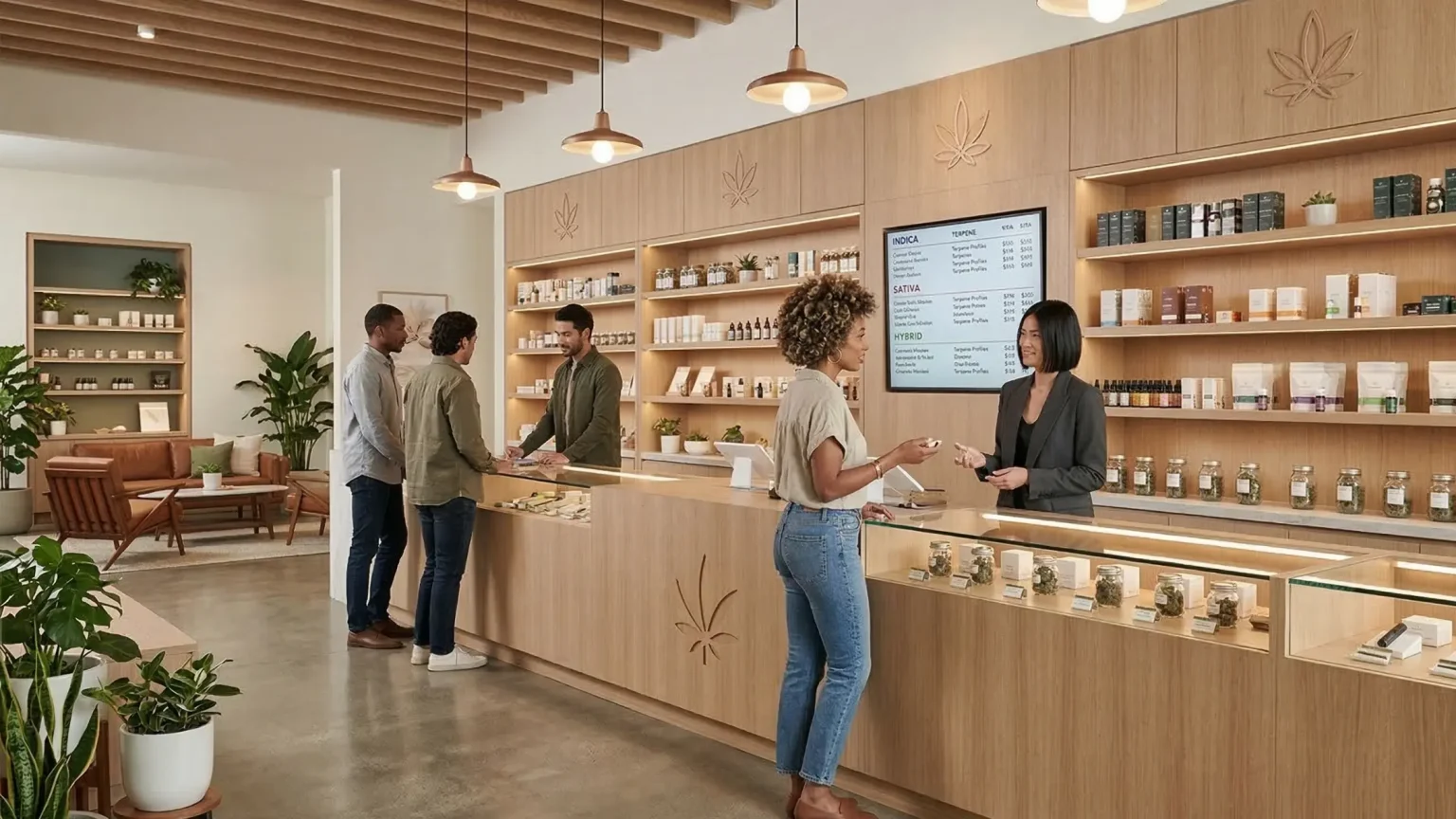
While cultivators and processors operate behind the scenes, the Retail Marijuana Store License allows you to be the highly visible, public-facing storefront of Virginia’s adult-use market.
Before you start scouting for premium real estate, you need to understand the intense competition and strict local zoning that defines this license. To succeed, you must navigate:
- A Highly Capped Market: Unlike processing or most cultivation tiers, retail licenses are strictly capped, meaning securing one will likely require winning a competitive lottery.
- Strict Zoning Rules: You cannot open a store just anywhere; the state enforces distance setbacks from sensitive community areas (though local governments may vote to reduce them), and you cannot locate a store where it would adversely affect the property values or tranquility of a residential zone.
- Strict Retail Constraints: Operations are highly regulated—there are hard caps on how much floor space you can use, how much product you can sell per transaction, and how you conduct sales.
Consumer Safety Mandates: You are the gatekeeper to the consumer and carry the legal burden of strict age verification, inventory tracking, and public health education.
What does the cannabis/marijuana retail license in Virginia allow?
The Retail Marijuana Store License grants you the legal authority to act as the final point of sale in the supply chain. Specifically, it authorizes you to:
- Direct-to-Consumer Sales: Sell marijuana, marijuana products, immature plants, seeds, and paraphernalia face-to-face to verified adults 21 years of age or older on your approved premises.
- Product Sourcing: Purchase and take possession of wholesale inventory from licensed marijuana cultivation facilities, processing facilities, or transporters.
- Home Delivery: Deliver products strictly in person to consumers at a residence (including temporary residences) or a business, or transfer your products to a licensed marijuana delivery operator to fulfill orders for you.
- Store-to-Store Transfers: Transport marijuana, marijuana products, immature plants, seeds, and paraphernalia from your licensed premises to another licensed retail marijuana store.
Key Restrictions & Market Caps
- Statewide Cap: The state will issue a maximum of 350 retail licenses.
- Store Size Limits: Retail stores are strictly limited to a maximum of 2,500 square feet of retail floor space.
- Strict Location Setbacks: Your store cannot be located in a residential area where it would adversely affect real property values or substantially interfere with the usual quietude and tranquility of the neighborhood, and must maintain a 1,000-foot setback from any hospital, higher education institution, child day program, or public, private, or parochial school (however, local governments may adopt an ordinance to decrease this minimum distance requirement).
- Transaction Limits: Transaction Limits: You are legally prohibited from selling more than two (2) ounces of marijuana (or an equivalent amount of marijuana products) to a single person in a single transaction.
- Sales Channel Bans: You cannot sell products using an automated dispensing/vending machine, a drive-through window, or through an internet-based sales platform operated by a third party.
- Age Verification: You must verify that the consumer is 21 or older using a valid, unexpired government-issued photo ID. Student identification cards are explicitly prohibited and do not constitute bona fide evidence of legal age.
- Mandatory Consumer Education: You must prominently display Board-approved pamphlets regarding the potential risks of marijuana use, and your employees must complete state-approved training on how to educate consumers about these risks.
- Human Trafficking Notice: You must post a highly visible notice of a human trafficking hotline on the premises to assist potential victims.
- Labor Peace Agreement: Like all marijuana establishment licensees, you must enter into, maintain, and abide by a Labor Peace Agreement with a bona fide labor organization.
Impact Licensee (Social Equity) Qualification
Securing a retail license in a capped market is highly competitive. Qualifying as an Impact Licensee provides you with significant advantages, including priority processing, specific lottery pools, and substantial financial assistance. To qualify, you must have at least 51% ownership and direct control by individuals who pass a strict two-part qualification test:
- Factor 1 (Residency): You must have resided between 1999 and 2025 in a jurisdiction determined to be “disproportionately policed” for marijuana crimes, OR you must have resided for at least three of the past five years in a historically economically disadvantaged community.
- Factor 2 (Life Status): You must also meet at least one of six specific criteria. These include having a prior marijuana-related conviction (or an immediate family member with one), being a U.S. military veteran, qualifying as a distressed farmer, receiving a Federal Pell Grant, or attending a public school in a disadvantaged community for at least five years.
Key Benefits & Restrictions for Retail Impact Applicants
- The “Double Chance” Retail Lottery: Disclaimer: Because retail licenses are strictly capped at 350, a lottery is highly likely. We added this to clarify how impact applicants participate). The state will conduct a specific, dedicated lottery solely for Impact Licensees for a set number of impact licenses. If you are not selected in this priority impact lottery, you are automatically entered into the general lottery pool, giving you a second chance to be selected.
- Financial & Real Estate Benefits: Impact applicants may receive preference in the licensing process, application and license fee waivers (to promote participation by those with an inability to pay), and access to grant or low-interest business loan programs. Crucially, you are explicitly waived from the requirement to show proof of funds or current possession and control of a property at the time of your application.
The 5-Year Transfer Constraint: To protect the integrity of the program and prevent predatory operating agreements, Impact Licensees cannot sell, assign, or transfer a controlling interest (more than 49%) in their license for a period of five years from the date the license is issued. The only exceptions the Board may allow are for transfers made as part of an estate plan to an immediate family member or a trust. (Note: If the state discovers an impact license was obtained through a fraudulent or predatory financial transaction, the license will be revoked and the applicant forced to repay all waived fees).
How CannDelta Helps You Secure a Retail License in Virginia
Securing a retail license in a capped market requires a flawless application and an airtight real estate strategy. CannDelta helps you build a lottery-ready retail brand:
- Zoning & Real Estate Strategy: Because winning the lottery only grants a “preliminary license approval,” we help you use your strict 18-month buildout window to secure a property that clears the 1,000-foot setbacks (unless locally reduced) and navigates the specific residential zoning restriction.
- Retail SOPs & Compliance: We draft the highly specific standard operating procedures (SOPs) required to pass state inspections, covering strict age verification, the 2-ounce transaction limits, and mandatory seed-to-sale inventory tracking.
- Staff Training Programs: We design the necessary employee onboarding materials to satisfy the state’s requirement for staff to be trained in discussing the health risks of cannabis use.
- Application Management: We manage the entire Virginia Cannabis Control Authority (CCA) submission process from start to end, ensuring your file is perfect to prevent immediate rejection under the strict 10-day deficiency rule.